Showing posts with label art. Show all posts

Art - series

Just like European nature protection series, 'Art' is traditional edition of Serbian post, that exsisted in Yugoslavian philately as well. These stamps usualy dedicated some anniversaries. They are mostly about Serbian art and artists, but there are also some stamps about great minds of world's art. Also, these stamps related to different types of arts: painting, sculpture, literature, music, architecture - and various periods, movements and styles.

Since 2012 these stamps always have insript 'Уметност' / 'Umetnost'.


2006.

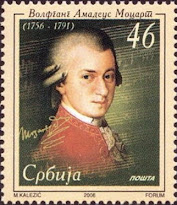
Wolfgang Amadeus Mozart (1756-1791). The stamp was issued for 250 years since the birth of great composer. The stamp depicts one of the most famous portaits of Mozart, painted by Barbara Krafft in 1819, with the notes in the backgound and Mozart's signature on the left.

Rembrandt van Rijn (1606-1669). The stamp was issued for 400 years since the birth of the painter. It depicts the painting "Self-portrait at the Age of 34" painted in 1640. Rembrandt's signature is added on the left.
 

2007. (all dedicated to painters)

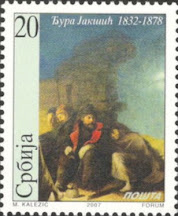
Đura Jakšić (1832-1878), 175 years since the birth (20 RSD stamp). Đura Jakšić is one the most important Serbian poets and artists, one of the leaders of Serbian Romanticism. The stamp depicts one of his most famous paintings, which has different names: 'The Rest after the Battle', 'Karaula' ('Guardhouse'), 'Lookout during night' or 'After the Battle'. The painting, which was painted in 1876, is based on a story about five guards who came around the fire to take a rest after they were defending their guardhouse from the Ottomans' attack.

Uroš Predić (1857-1953), 150 years since the birth (46 RSD stamp). Uroš Predić was Serbian painter and one of the most important representatives of realism in Serbian art history. The stamp shows the painting 'Boy in front of the shop window' from 1879.

Frida Khalo (1907-1954), 100 years since the birth (46 RSD stamp). This famous artist from Mexico is well known for her self-portraits and the stamps depicts 'Self-portrait with small monkey' from 1945.
  

2008. Predrag Peđa Milosavljević (1908-1987), 100 years since the birth. Peđa Milosavljević was Serbian painter, lawyer and diplomat. He was awarded multiple times for his artwork. 20 RSD stamp depicts painting 'The Cluny museum in Paris' and 46 RSD stamp depicts painting 'Notre Dame in Paris'.


2009. (all dedicated to painters)

Milena Pavlović Barili (1909-1945), 100 years since birth (22 RSD stamp). Pavlović-Barili was Srbian artist and poet, the most notable female artist of Serbian modernism and one of the most important female Serbian artist. The stamp depicts the painting 'The self-portrait with the veil'.

Jovan Bijelić (1884-1964), 125 years since birth (46 RSD stamp). Bijelić was Serbian and Yugoslavian painter, one of the most important representatvies of color expressionsm in Yugoslavia. The stamp depicts the painting 'Still life with the parrot'.

Paja Jovanović (1859-1957), 150 years since birth (46 RSD stamp). Jovanović is one of the most important painters in history of Serbian art and probably the most notable painter of domestic realism. The stamp depicts the painting 'Young woman in a pink dress'. 


2011. (all dedicated to artists)

Katarina Ivanović (1811-1882), 200 years since birth (22 RSD stamp). Katarina Ivanović was one only three female painters in 19th century in Serbia. Also, she was the first woman who painted historical compostion and portrait of another woman in Serbian art history. She painted 38 paintings in total. The stamp depicts Ivanović's 'Self-portrait'.

Uroš Knežević (1811-1876), 200 years since birth (33 RSD stamp). Knežević is part of the group of a few Serbian painters born on the teritory of Austrian-Hungarian Empire, but who came to Serbia and stayed here. He was well known for his portraits and his works 'track' civil society in Serbia in 19th century. The stamp depicts the painting 'Portrait of woman in folk clothes'.

Đorđe Jovanović (1861-1953), 150 years since birth (44 RSD stamp). Jovanović was one the first educated sculpors in Serbia. He created numorous busts, stutes and medals. He received multiple awards, including the ones from World's fairs. The stamp depicts Jovanović's 'Self-portrait'.

Bora Baruh (1311-1942), 100 years since birth (66 RSD stamp). Baruh was painter and lawyer. He got art education in Belgrade and Paris. He was carrying out revolutionary acitivities, spreading comunist propaganda between the world wars, so he was often arrested. During the Second world war he was captured by Germans and shot. The stamp depicts painting 'Self-portrait with wife and son'.


2012. Architecture

Department store in Belgrade (22 RSD stamp). This building represents the most successful and most pure example of Secession architecture in Belgrade. It was built in 1907, in those days main trade street, according to the plans of architect Victor Azriel. It was built for Bencion Buli, famous banker and representative, as the first modern department store in Belgrade, completely different from traditional stores. It was a little miracle in Belgrade in those times, because of the wall build of metal and glass, with enterier inspired by Paris architecture. The building was preserved and today there is located a big coffee shop.

Telephone exchange building in Belgrade (33 RSD stamp). The architectural design for this building was made by the architect Branko Tanazević, the most prominent representative of the national style in Serbian architecture in the first half of the 19th century. It is considered that Tenezović created Serbian version of Secession in his workds, including this building, by using decorative elements based on the medival Moravian School style. The construction of the building started in 1908, and the telephone exchange started working in 1910. It was the first object for that purpose in Serbia. Since the number of offices did not satisfy the needs of the postal and telegraph service, the officials proposed an additional floor to be constructed in 1919. The building was finished in 1925 and has kept its shape until today.

Hotel 'Moskva' ('Moscow') in Belgrade (46 RSD stamp). This is one of the most important buildings in Belgrade. In the early 20th century, the Insurance Company ”Rossia“ from St. Petersburg, bought land at the corner of Kralja Milana (today Terazije square) and Balkanska Street, in order to build a facility for its company. The Company announced the open competition for the construction of the building. The first prize and the right to realization, won the work of architect Viktor Kovačić from Zagreb, but the management of the Company in St. Petersburg disagreed with the decision of the jury, and accepted the design of Jovan Ilkić, awarded the second prize. After joint cooperation, the design was signed by the architect Pavel Karlovič Bergštreser, ”head-architect“ of the Insurance Company ”Rossia“, but the project was realized under the supervision of Ilkić. Green ceramic tiles which made a special decorative colourful façade formwork, were designed in the famous factory of maiolica and ceramic ornaments ”Zolnaj“ from Pecs. This palace with a café and the Moskva Hotel, was opened by King Petar I Karađorđević in 1908. This building was place for many importnant moments in Serbian history. The Hotel became the headquarters of the Journalists and Writers Association. In 1910, this was the place where the Olympic movement was founded in Serbia. In 1923, the first post office windows of the Postal Savings Bank were open here. Many famous Serbs and Yugoslavs were often guests of the hotel, like Ivo Andrić and Vasko Popa. It was visited by Albert Einstein, Jean-Paul Sartre, Alfred Hitchcock, Miloš Forman, Indira Ghandi, Luciano Pavarotti, Orson Welles, and many others. By the middle of the 20th century, the building was declared cultural monument under state protection.

100 years of City hall in Subotica (55 RSD stamp). Subotica is the northern city in Serbia. Since it was part of Austrian-Hungarian Empire, it was city of Secession. Today’s City Hall is the third built on the same location. In 1902 Karolj Biro became mayor of Subotica. Some of the most important city buildings from the beginning of the 19th century were built under his supervision. An open competition for the construction of the City Hall was annoinced in 1906. One of the conditions of the competition related to the construction style which had to be baroque in the honour of the Habsburg Empress, Maria Theresa, because the city enjoyed the free royal city status bestowed upon it by the Empress. The first prize at the competition won architects from Budapest, Marcel Komor and Deže Jakab. The City Hall was finished in 1912. as an omen of the New Age, and administration house in the service of the citizens. It's rich Secessionist decoration was inspired by folklore motifs of embroidered parts of national costumes and architecture from Transilvania.


2013. (all dedicated to importnant anniversaries in classical music)

Oskar Danon - 100 years since birth (1913-2009), (22 RSD stamp) - Serbian and Yugoslav conductor and composer, a member of Academy of Science and Arts of Bosnia and Hezegovina.

Richard Wagner - 200 years since birth (1813-1883), (46 RSD stamp) - one of the greatest German composers and creators of operas. Beside Wagner's portrait, the stamp depicts musical notations for operas 'Tristan and Isolde' and 'The Flying Dutchman'.

Giuseppe Verdi - 200 years since birth (1813-1901), (50 RSD stamp) - one of the greatest Italian composers of all times. The stamp depicts his portrait and musical notation for opera 'La Traviata'.


2014. (all dedicated to importnant anniversaries in literature)

150 years since birth of Branislav Nušić (1864-1938), (22 RSD stamp) - one of the greatest Serbian writers, especially known for his comedies.

200 years since birth of Mikhail Lermontov (1814-1841)(46 RSD stamp) - Russian romantic writer and poet. On the stamp, beside the portarait of Lermontov is depicted his novel 'Hero of our times'.

450 years since birth of William Shakespeare (1564-1616)(50 RSD stamp).


2015. (two anniversaries in art)

125 years since the birth of Petar Dobrović (23 RSD stamp), Serbian painter (1890-1942). The stamp depicts his painting 'Street in Amsterdam'.

200 years since the birth of Dimitrije Avramović (70 RSD stamp), Serbian painter and writer (1815-1855). The stamp depicts his work 'Prince Lazar's dining room / dome of Manasija'.


2016. (This year the Art edition was dedicated to various art anniversaries and it was issued in the form of a booklet. Every stamp depicts the artist and a symbol of the art he belongs to.)

225 years since the birth of Sima Milutinović Sarajlija (1791-1847), Serbian poet. 

175 years since the birth of Laza Kostić (1841-1910), Serbian writer, one of the most important representatives of romanticism in Serbian literature. On the stamp are also depicted the church Santa Maria della Salute in Venice and portrait of Lenka Dunđerski. 'Santa Maria della Salute' is one Kostić's most important songs and it was inspired by Kostić's love Lenka Dunđerski.

125 years since the birth of Stanislav Vinaver (1891-1955), Serbian writer, on of the most important representatives of avant-garde in Serbian literature.

125 years since the birth of Tin Ujević (1891-1955), one of the most important Yugoslavian and Croatian poets.

125 years since the birth of Mihail Bulgakov (1891-1940), Russian writer. On the stamp, next to Bulgakov is depicted the cat - Behemoth, character from Bulgakov's novel 'The Master and Margarita'.

125 years since the birth of Lajos Zilahy (1891-1974), Hungarian writer, one of the most prominent Hungarian autrhors of the 20th century. On the stamp is also depicted quote from his book 'The Soul Extinguished'.

150 years since the birth of Wassily Kandinsky (1866-1944), Russian painter, one of the most important representatives of Expressionsim movement.

175 years since the birth of Antonín Dvořák (1841-1904), Czech composer and conductor of Romantic music. On the stamp is also depicted music sheet for the 'Symphony no. 9' ('Symphony of the New World').


2017. (Similar like the previous year, this edition selected some anniversaries, issued in the form of booklet, with the stamps that depict the artist and a symbol of the art he belongs to.)

275 years since the birth of Dositej Obradović (1742-1811), writer, linguist and educational reformer He was  representative of the Enlightenment movement. The philosophical background of his programme was the Enlightenment rationalism, adapted to the practical needs of Serbian people. In 1808 he established the Higher School in Belgrade (University today) and the Seminar in 1810. He was the first minister of education in Serbia.

225 years since the birth of Haji Nikola Živković (Haji-Neimar) (1792-1870), manager of all constructions built during the rule of Prince Miloš. According to this role, he is considered to be the first Serbian architect. On the stamp behind his portrait is depicted the Residence of Princess Ljubica, which was contructed by Haji Neimar. The Residence of Princess Ljubica and The Residence of Princ Miloš in Topčider are two representative buildings of the transitory type from Oriental to Occidental (West European) architecture in Belgrade and Serbia.

200 years since the birth of Anastas Jovanović (1817–1899), the first Serbian lithographer and one of the first Serbian photographers. He is famous for making talbotype portraits of prominent people. In Vienna, he was the first artist ever to make stereoscopic images. He made more than 200 lithographic images and over 800 photographs of people and events from the Serbian history, and made designs for the first Serbian post stamps. On this stamp he is portraited with his objective 'Joseph Petzval’s objective – Model 3'.

150 years since the birth of Vasa Eškićević (1867-1933), Serbian painter and drawing teacher. He painted in the style of academic realism with the elements of expressionism. 

125 years since the birth of Milutin Bojić (1892-1917), Serbian poet. He participated in the First World War and died on the Thessaloniki front, leaving his works about Serbian loses in the War.

125 years since the birth of Ivo Andrić (1892-1975), Yugoslavian and Serbian writer and diplomat. He won the Nobel Prize in Literature in 1961. The Nobel Committee cited "the epic force with which he ... traced themes and depicted human destinies drawn from his country's history".


2018. (Literature anniversaries - in the form of a booklet and two rows of se-tenant stamps with connections through books)

200 years since the birth of Ivan Sergeyevich Turgenev (1818-1883), the most important representative of Russian realism, a short story writer and novelist.

175 years since the birth of Kosta Trifković (1843-1875), Serbian writer and one of the best comediographers of the time. 

150 years since the birth of Maksim Gorky (1868-1936), one of the greatest Russian writers.

150 years since the birth of Aleksa Šantić (1868-1924), Serbian poet of patriotism, but also of emotional pain.

125 years since the birth of Miloš Crnjanski (1893-1977), one of the greatest Serbian writers of the 20th century, representative of the post-war modernists in Serbian literature, winner of the NIN award for the best novel  (the greatest literary award in Yugoslavia and Serbia) in 1971 for 'A Novel of London'.

100 years since the birth of Aleksandr Isayevich Solzhenitsyn (1918-2008), a Russian writer, Nobel Prize winner and dissident, who was also a member of the Serbian Academy of Sciences and Arts.


2019. (Art anniversaries - in the form of a booklet)

125 years since the birth of Zora Petrović (1894-1962), painter. On the stamp is represented her work 'Girl from Skopska Crna Gora' (1952).

125 years since the birth of Risto Stijović (1894-1974), sculptor. The stamp depicts his work 'Torso of a Girl' (1971).

125 years since the birth of Dušan Janković (1894-1950), artist, architect and designer. The stamp depicts his drawing 'Paris' (1926).

125 years since the birth of Ivan Radović (1894-1973), painter. On the stamp you can see his painting 'Landscape with round tree tops' (1922).

150 years since the birth of Henry Matisse (1869-1954), one of the gratest artists of the 20th century, who set the Fauvism art movement. The stamp depicts his painting 'By the Window' (1918).


2020. (modern artists)

Petar Dobrović (1890-1942), 130 years since birth. He was one of the most important painters belonging to the 20th century civic modernism movement. The stamp depicts his painting 'Old Bepo' (1940).

Vera Božičković Popović (1920-2002), 100 years since birth. She was visual artist, one of the most distinguished members of Belgrade informalism. The stamp depicts her work 'The Pit' (1968).

Kosta Bogdanović (1930-2012), 90 years since birth. He was sculptor and art historian and theoretician. The stamp depicts his work 'Home Organ' (2008).

Leonid Šejka (1932-1970), 50 years since the death. Šeka was artist and art theoritician. The stamp depicts his work 'Museum exibition' (1956).


2021.

125 years since the birth of Sava Šumanović (1896-1942).Šumanović was one of the most important Serbian painters of all time, tragically murdered by Ustashas during the occupation of Serbia. The stamp depicts his painting 'Pickers-Evenke' from 1939. 

100 years since the birth of Zoran Petrović (1921-1996), Serbian and Yugolavian artist. The stamp depicts his painting 'A Guest Hates Another Guest, and the Host Hates Both', from his cycle 'Folk Proverbs', 1955.


2022. Achitecture – The Bajrakli Mosque in Belgrade

The Bajrakli Mosque is the main Islamic cultural centre in Belgrade. It is a one-room building with a dome and minaret, built around 1522. It was originally called the Čohadži Mosque, after the endowment donor, the baize merchant, Hadži Alija. After the renovation in 1741, it was called Hussein-bey’s mosque for some time, and at the end of the 18th century it was named Bajrakli-mosque, after the flag that stood out on it as a sign for the simultaneous beginning of prayer in all mosques. The architecture of the mosque belongs to the type of one-room cubic building with a square base, with an octagonal dome supported by eastern subdome arches and niches - trompes, with modest console decoration and a minaret. It is built of stone, with massive walls with few openings. The interior decoration of the mosque is modest, with rare stylized floral and geometrized motifs and calligraphic inscriptions of verses from the Koran on the walls. Due to its antiquity, rarity, preservation of its original purpose, as well as the representativeness of religious architecture and Islamic culture, the mosque was placed under state protection as a cultural monument in 1946, and in 1979 was declared a cultural asset of great importance.


2023. (anniversaries of art institutions)

50 years since the establishment of the University of Arts in Belgrade. The Academy of Arts was formed in 1957 as Association of Higher Art Schools – Academy of Music (founded in 1937), Academy of Fine Arts (founded in 1937), Academy of Applied Arts (founded in 1948) and Academy of Theater Arts (founded in 1948, into which the Higher School of Film Acting and Directing was integrated in 1950). In 1973 the Academy of Arts grew into the University of Arts, which consists of four faculties: the Faculty of Fine Arts, the Faculty of Music, the Faculty of Applied Arts and Design, and the Faculty of Dramatic Arts. Since its establishment, the University of Arts in Belgrade, as the leading institution for art education in Serbia and the region, has played a key role in shaping the art scene in Serbia and is one of the foundations on which Belgrade has built its reputation as a creative center and capital of culture.

100 years since the founding of the Belgrade Philharmonic Orchestra. Stevan Hristić, оne of the most important Serbian composers and conductors, formed an orchestra from musicians of the National Theater Opera, teachers of Belgrade music schools and several amateurs, which, under the name of the Belgrade Philharmonic, held its first concert on June 13, 1923. The 100-year long history of the Philharmonic consists of a diverse musical repertoire performed on stages all over the world, 620 musicians who have spent their working lives there since the archive has been continuously maintained (1951), 16 artistic directors, numerous guest conductors and musicians – the world’s most famous names in music art, but also enthusiastic audiences on all continents. The Belgrade Philharmonic entered the new millennium under the leadership of Ivan Tasovac after several difficult years at the end of the last century. He has returned this ensemble to the very top of the world’s orchestras and among one of the most successful cultural institutions in the country and region. The stamp depicts a violin, emblem of the Belgrade Philharmonic Orchestra and the portrait of Ivan Tasovac.

70 years since the establishment of the Gallery of the Central Military Club. The Gallery of the Central Military Club is located in the monumental building of the palace of the former Military Home, today the Central Military Club. The initiative to establish the Gallery was initiated in 1945 by the well-known fine artist and founder of the Faculty of Applied Arts in Belgrade, Branko Šotra. Since the beginning of the Gallery’s work in 1953, numerous themed exhibitions of Yugoslav artists have been organized, dedicated to the revolution and the national liberation struggle, but artists have also organized independent exhibitions without thematic restrictions. This type of activity of the Gallery had a direct impact on the formation of the Art Collection, for which works were acquired through purchases, gifts, in exchange with institutions, and sometimes through the engagement of fine artists.


2025.

100th anniversary of the birth of Zuzana Chalupová. Zuzana Chalupová (1925–2001) was naive artist from Kovačica municipality in Vojvodina (village with Slovak national minority). She is the most famous female representative of Kovačica naive art movement. The main motif of her work is the children, therefore she was named “Mama Zuzana”. Well-known are her paintings of winter, which fascinate with their captivating colours and perfect compositions. She used to paint views of everday countryside life and views. Her works today adorn many galleries and museums around the world. She has exhibited, individually and in groups, at numerous exhibitions throughout the country and the world. She was also giving her to UNESCO, UNICEF and Red Cross for charity. The stamp depicts portrait of Zuzana Chalupová and her painting "Play on Snow" (1977).

100 years since the birth of Janika Balázs. Jovan Janika Balázs (1925–1988) was born in Lukino Selo near Zrenjanin in Vojvodina. He was the most eminent prim-tambura artist from these areas. He spent most of his life and worked in Novi Sad and Petrovaradin. He started playing at the age of six. He gained worldwide fame with the “Small Tambura Orchestra” and his role in the film “I Even Met Happy Gipsies”, which led to a concert at the famous Olympia in Paris, as well as other performances through Europe and the world. In addition to playing, he also wrote arrangements, lyrics, and music. Ratko Šoć dedicated the song “Eight Tambura Players” to him, after which the orchestra would be named. The stamp depicts portait of Janika Balázs and view of Petrovradin behind him.


Museum Exibits

The first series of Museum exibits were issued since 1975 in Yugoslavia. Serbian post continued this tradition, issuing stamps titled as "Museum exibits". These stapmps depict different types of museum items, kept in many museums in Serbia. They are proof of exceptional cultural heritage of Serbia.

2006. Museum exibits

Stamps from this edition depict jewelry as museum items.
16,50 RSD - crown, 19th century
16,50 RSD - ring, 18-19th century
46 RSD - earrings, beginning of the 20th century
46 RSD - necklace, beginning of the 19th century

It seems like this commemorative edition was an inspiration for three 2009-2018 regular stamps.

2007. Gamzigrad - Felix Romuliana

Felix Romuliana is archological site located near city of Zaječar in eastern Serbia. It is the imperial palace of the Roman emperor Gaius Valerius Maximianus Galerius (305-311, period of Tetrachy). It was built in 3rd or 4th century. Galerius named the palace Felix Romuliana after his mother Romuliana. On the site were found well preserved palaces and temples, with mosaics, sculptures and other artifacts. In 2007 the palace got protection as UNESCO world heritage site (WHS) and theat was the reason to issue these stamps. Two stamps were issued, both with 46 RSD face value. They depict ruins of the archeological site, with logo of UNESCO.

2008. Children's folk costumes

Folk costumes are usual items kept in etnographic museum collections. 46 RSD stamp depicts children folk costume from Šumadija and 50 RSD stamp depicts the one from Kumodraž. Motifs on both stamps are actually watercolor paintings created by painter Olga Benson during her stay in Serbian villages 1947-1948. These works are part of etnographic-folklore collection of the Institute of Etnography, which is part of the Serbian Academy of Sciences and Arts.


2009. Dinosaurs of Argentina in Belgrade

The biggest exibition in 2009. in Serbia took place in Natural history museum in Belgrade. It was exibition of dinosaurs from Argentina. The exibition was named "Dinosaurs of Argentina - Giants of Patagonia". The exibition presented 20 species of dinsouarus and around 40 skeletons or skeleton parts, dinosaur eggs, bones, nests, footprints. There were 7 completely reconstructed skeletons. The exibition was opened from June 2009 to March 2010 (the duration was even increased because of the great attendance). Issued stamps depict two skeletons which visitors could have seen: Herrerasaurus ischigualatensis on 22 RSD stamp and Gigantosaurus carolinii on 46 RSD stamp.

2010. 60 years since the founding of the Museum of Applied Arts in Belgrade

Museum of Applied Arts was founded in 1950. It is museum specialised for collecting, protecting, studying, exhibiting and publishing works of applied arts. The Museum's collections reflects the development of objects of applied art in a 2400 years span. The Museum disposes around 37000 objects of applied art sorted in collections such as metal and jewellery, furniture, textille and costume, photography, ceramics, glass and porcelan, contemporary designs, urbanism and architectural design. The stamps issued for this occasion depict: a glass from Serbia, the end of the 16th century, on 22 RSD stamp and a figure from Germany, 19th century, on 44 RSD stamp.


2011. 100 years of the Dužijanca celebration

Dužijanca is celebraion of the end of the harvest, which has been celebrated in city of Subotica. It is custom of Bunjevci people and it is an expression of faith and culture, a kind of combination of prayer and thanksgiving. The first church manifestation was organised in 1911 and the first civil manifestation was held in 1968, and they were both united in 1993. The 22 RSD stamp depicts the model of Cathedral in Subotica and the 55 RSD stamp depicts '100 th Dužijanca' crown. Both items are kept in the Museum of Roman-Catholic Diocese of Subotica.

2012. National museum of Kruševac

The National Museum of Kruševac was founded in 1951. It has been developed into a museum which treasures more than 23000 exhibits, gathered in collections such as archaeology, history, numismatics, nature, ethnology. 22 RSD stamp depicts the bronze statuette of a Roman. It was found during archaeological researches of the Lazar City (medieval Kuševac). The statuette represents a young Roman dressed in toga, holding a spear in his right hand, and a scroll or a money bag in the left hand. The exhibit comes from the fourth century A.D. 55 RSD stamp depicts a parade officer sabre. It belonged to the infantry second lieutenant Dragobrat Ž. Petrović from Kruševac. Upon formation of Kingdom of Serbs, Croats and Slovenes, all the officers received the sabres with ornate knuckleguard and the basket decorated with the coat of arms of the newly-formed country. The name of the supplier "OFFICERS COOPERATIVE" is engraved on the blade, incorporating the Kingdom coat of arms.


2013. 50 years of the Historical museum of Serbia

The Historical museum of Serbia was founded in 1963. The Museum’s primary mission is to collect, register, preserve, handle, study and exhibit materials related to the Serbian people and Serbia from ancient times to the present. Chronologically, the subject matter of the Museum, which covers all the important processes of the development of the Serbian entity with particular stress on the periods of national liberation, is divided into several parts: the Middle Ages, the period of foreign domination, the period from 1804 to 1918, the period after World War One, the period of the National Liberation War 1941–1945, and the post-war development of Serbia. Musum has many collections such as weapons, flags, maps, uniform, coins, medals, documents, and so many more. Unfortunatelly, the Museum doesn't have permanent exibition in it's main bulding. Authorities are trying to solve some administrative problems so the Museum could get new building and space that it deserves.

22 RSD stamp depicts the Gospel of King Aleksandar Obrenović from 19 century. It was a gift from the brotherhood of the monastery Zograf, 1896, made in Kiev Pechersk Lavra. It was made of black enamel, gold, enamel and precious stones. 50 RSD stamp depicts the Crown of King Petar I Karađorđević, made in 1904 in the Falize Frères jewellery workshop in Paris. It was made according to the draft of Mihailo Valtrović, cast from the handle of Karadjordje's cannon.

2014. Serbian heraldry

The Serbian heraldry and heraldic badges have originated during the medieval Serbian state among the then nobility. Serbian heraldry belongs culturally to the Byzantine tradition. This edition depicts two coat of arms which are modern sketches from the II Belgrade Armorial from 17th century. II Belgrade Armorial is collection of 158 paginated pages with images of coats of arms of South Slavic countries, states of Emperor Dušan and Uroš, and 141 coat of arms of noble families. The collection dates back from the 17th century. The 23 RSD stamp depicts the coat of arms of Serbian medieval Nemanjić dynasty. The animal of this dynasty was two-headed eagle. The 69 RSD stamp depicts coat of arms of Branković dynasty, with the lion as the main part of the coat of arms.


2015. Religious works

From 2015 Museum exibits editions contain more than two stamps. 2015 edition is dedicated to anniversaries of three religious works. All three works are kept in The Gallery of Matica Srpska in Novi Sad. 

23 RSD - 200 Years of the Saint Peter and Paul with the Presentation of Bela Crkva Copperplate. This work is coloured copperplate on paper by unknown copperplate engraver from 1815. The graphic sheet of this copperplate is dominated by a rectangular field with the saints between which is the temple-front of the Bela Crkva church. On the left and the right there is a text containing a short explanation of the represented, written in big cyrillic letters. In the lesser rectangular, under the saints’ feet, the panorama of Bela Crkva is shown with three parts of the settlement.

35 RSD: 275 Years of the Monastery Studenica Copperplate. This is copperplate on paper from 1740 (the 1965) print by Gotfrid Dirst. Almost nothing is known about the author of the copperplate, the Pest graphic, Gotfrid Dirst. The central part of the composition belongs to the Church of the Dormition, an endowment and a crypt of the founder of the Serbian state and the monastery itself, Stefan Nemanja.

70 RSD: 275 Years of the Saint Demetrius Icon. This work is tempera on wood, created from 1735 to1740 by Hristofor Žefarović. Saint Demetrius, the patron of town Sremska Mitrovica, is painted on a rearing fiery horse, as he stabs Bulgarian tsar Kaloyan, who falls on the grassy surface covered with bunch of tiny flowers. Icon was found in the bell tower of the Church of Three Holy Hierarchs in Novi Sad (Almas church).


2016. Stećci

Stećak or stećci in plural are monumental medival tombstones. They were found lie scattered across Bosnia and Herzegovina and the border parts of Serbia, Croatia and Montenegro. It is assumed they first appeared in the second half of the 12th century. They were most intensively hewed in the 14th and 15th century. They are mostly founded in poor condidtion. In Serbia were found about 2100 sećci. Stećci – Medieval Tombstones Graveyards in Bosnia and Herzegovina, Montenegro, Croatia, and Serbia were inscribed on UNESCO’s World Heritage List on 15th July 2016. For that occasion sećci were presented in 2016 Museum exibits edition.

23 RSD. Three of life (14th century), found at Burđića Rast necropolis neear town Krupanj.
46 RSD. Dragon (14th century), found at Mramorje at Lipenović necropolis near town Krupanj.
50 RSD. Arcades (14/15th century), found at Greek Cementery in village Hrta near town Prijepolje.

2017. The House of Jevrem Grujić

Jevrem Grujić was a Serbian lawyer, politician, statesman and diplomat in the mid to late 19th century. He was an important figure of Sebian political liberalism in that period. He was a minister a few times, judge in the Great Court and diplomat in Istanbul, Paris, London and Brussels. His house was designed as a one-storey urban villa inspired by French neo-baroque and neo-renaissance styles. The house is the first cultural monument protected by the Institute of Protection of Cultural Heritage of the City of Belgrade after its foundation in 1961, and in 1979 the building was declared the cultural heritage of great significance for the Republic of Serbia. In 2015, thanks to the generosity of heirs of Jevrem Grujić, a section of the house was made into Museum, in which a part of the rich collection of Jevrem Grujić’s House is now displayed. The House of Jevrem Grujić gives an atmosphere of late 19th century, lived by upper class.
The stamps depict four paintings which are displayed in this museum - all represented even with their frames:
23 RSD. Painting "Jevrem Grujić", by Steva Todorović, oil on canvas, 1888,
46 RSD. "Mileva Naumović", by Uroš Knežević, oil on canvas, 1854,
50 RSD. "Jelena Milojević with Daughters Milica and Milena", by V. Volkov, oil on canvas, 1925,
70 RSD. "Queen Natalija Obrenovitć", by Steva Todorović, oil on canvas, 1884.

2018. 95 years since the founding of the PTT Museum

PTT Museum (Postal-Telegraphic-Telephone Museum) is a technical museum that collects and presents objects and documents related to the operation and development of postal, telegraphic and telephone communications. It was founded in 1923. Today it functions as a museum within the Public Enterprise Post of Serbia. The museum exhibition is divided into six sections and it represents a chronological overview of the development of PTT communications from 1815 to now, with various exhibits that interdependently and mutually illuminate the social, cultural and economic history in addition to the history of communication of the modern Serbian state. Reconstructed museum space and new permanent exhibition were officially opened for public in 2013.

Stamps issued in this edition depict some items kept in PTT Museum and represent history of communication.
23 RSD. Mail coach from 19th century manufactured in Milan, Italy, in company of Cesare Sala. It was made according to the look of English royal mail coaches.
46 RSD. Inductor telephone type 'Ericson'. It was personal telephone of the King Petar I Karađorđević, he used from 1904 to 1911. In the background of the stamp can be seen the King.
50 RSD. Inductor telephone exchange from Sarajevo. This one was used to report news that Gavrilo Princip killed Franz Ferdinand on 28th June 1914.
70 RSD. Hughes' printing telegraph. Created by British inventor David Edward Hughes, this machine was used in the Kingdom of Serbia since 1891.


2019. 175 years of the National Museum in Belgrade

The National Museum in Belgrade is the oldest and probably the most important museum in Serbia. It conserves, studies and exhibits more than 450,000 of museum items which represent a unique whole of the cultural heritage of Serbia, Central Balkan, as well as Europe. It is located in the very centre of Belgrade at the Republic Square. The National Museum conserves representative cultural goods, testimonies of development and civilization changes in the territory of today’s Serbia and the closest surroundings, from the prehistoric times until the late Medieval period, as well as the representative works of the key artistic styles and movements. Except works of national artists, the Museum keeps some works of the most important European artists such as Bosch, Brueghel, Van Gogh, Mondrian, Corot, Pissarro, Degas, Picasso, Kandinsky, Chagall and others. The Museum has 4 collections: archeological, numismatic, artistic and historical.
The 2019. issues is contained of two stamps. One represents a national piece of art, and the other one represents a piece of European art.
23 RSD. Sculpture 'The Boy Plucking the Thorn' by Simeon Roksandić, bronze, 1922.
74 RS. Painting 'Bather' by Auguste Renoir, around 1915.

2022. 

After 2 years break, the 2022 issue doesn't have unique theme. There were issued three stamps about three anniversaries.

a) 175 Years of the founding of The Gallery of Matica Srpska
The Gallery of Matica Srpska is one of the oldest national art museums. The Gallery was established as part of Matica Srpska, the oldest cultural and scientific organisation of Serbs. As the Matica Srpska, the Gallery was also established in Budapest, Austo-Hungarian Empire. The Gallery was established in 1847, with contributions from Sava Tekelija who left a valuable family portrait collection to the Matica Srpska, and other Serb merchants who made endowments and donations to the gallery. Today, both Matica Srpska and the Gallery are located in Novi Sad, Serbia. The Gallery is independent institution since 1958. The collection, primarily oriented towards painting, numbers 10,000 works of art. It is divided into 16 collections and includes examples of paintings, graphics, sculptures, drawings, applied art.
The stamp depicts the painting 'Anka Topalović née Nenadović', by Katarina Ivanović (1837).

b) 175 Years of the Founding of the Museum of Vojvodina
The roots of the Museum of Vojvodina are also connected to the Matica Srpska. In 1847 Matica Srpska decided to establish the Serbian national collection or museum. The first museum collection was created from the legacy of Sava Tekelija, and was presented only after the opening of the Museum of Matica Srpska in 1933. After the Second World War, part of the material was separated from here and the Vojvodina Museum was established as a museum of a complex type, the largest of its kind in Serbia, with collections ranging from archaeology, ethnology, history, art history to zoology, botany, geology, palaeontology and mineralogy. From the funds of the Vojvodina Museum, many institutions in the sphere of cultural and nature protection branched out, such as Museum of the City of Novi Sad, Theatre Museum of Vojvodina, Institute for the Protection of Cultural Monuments, Institute for Nature Protection. Today, this institution has a rich collection of around 400,000 items and a specialized library.
The stamp depicts Roman gilded helmet from 4th century AD. The Museum has two more helmets of this type. Those helmets are one of a kind in this part of Europe and that is why they are considered to be an informal trademark of the Museum.

c) 75 years since the founding of the Institute of Archaeology
The Institute of Archaeology was founded in 1947 in Belgrade with Professor Vladimir Petković appointed as its first Administrator. One of the goals was to study of the development process of human civilization based on archaeological material in the territory of Serbia and in its surroundings. From its foundation until today, the institution has carried out a series of large-scale researches of archaeological sites of various forms and scopes, as well as performed the protection of material cultural assets. The work of the Institute in recent times is particularly characterized by fruitful cooperation with institutions and colleagues from the country and abroad, which is reflected through the introduction and application of modern scientific methods in research practice. By studying the material remains with the implementation of modern scientific approaches, results are obtained that allow us to more clearly reconstruct the way of life, culture, art and the scope of human mind in Serbia over the centuries, which today represents the most important scientific activity of the Institute.
The stamp depicts a photo of members of the Serbian arcehological society, who participated in founding the Institute of Archaeology. On the upper right part of the stamp you can also see logo of the Institute.


2025. 

After 2 years break, the 2022 issue doesn't have unique theme. There were issued three stamps about three anniversaries.

a) 75 Years of the founding of Museum of Applied Arts

As in 2010, this stamp is also about Museum of Applied Arts. The stamp depicts the building and logo of the Museum, decorated dessert tray, illustration of Aleksandar Joksimović, signet ring.

b) 75 years of the Railway Museum

The Railway Museum, preserves history of railways in this region. It is located in the building of the former Ministry of Transport in Belgrade. The Museum was founded in 1950.  It preserves the memory of the people who built the railways, operated the trains and took care of their maintenance. The Railway Museum was founded as the only museum of its kind in Yugoslavia. The museum collections are as follows: Technical, Historical, Applied Art Collection and Art Collection. Through its collections, Library and Archives, the Museum allows visitors to enter the world of railways. The stamp depicts building of the museum, the medal encrusted with emeralds (obverse) awarded by the Wagons-Lits company to its employee Milan Ciganović in 1938, George Stevenson’s 1875 steam locomotive model.

Popular Posts

LAST ISSUE FROM SERBIAN POST

LAST ISSUE FROM SERBIAN POST
Notable Serbs (2026)